Recent updates 🗞️
🇬🇧 Andy Burnham replaces Starmer — Britain’s 7th prime minister in a decade
💰 FIFA banks ~$9B from the most lucrative sporting event in history
🏛️ Warsh Fed holds at 3.50–3.75% in a 9-3 split — most divided vote since 2016
📚 Reading “The Algorithm” by John McNeill
🎥 Watching “Your Friends & Neighbors S2”
YTD Portfolio Performance: +24.19% YTD
Last month, one of the most spectacular hedge fund runs in modern history ended in a fire sale. Situational Awareness LP, the AI-focused fund run by former OpenAI researcher Leopold Aschenbrenner, was forced to sell essentially its entire public stock portfolio, roughly $16 billion, to Ken Griffin’s Citadel after margin calls from Goldman Sachs, JPMorgan, and Bank of America. The fund lost about 67% of its value in a single month.
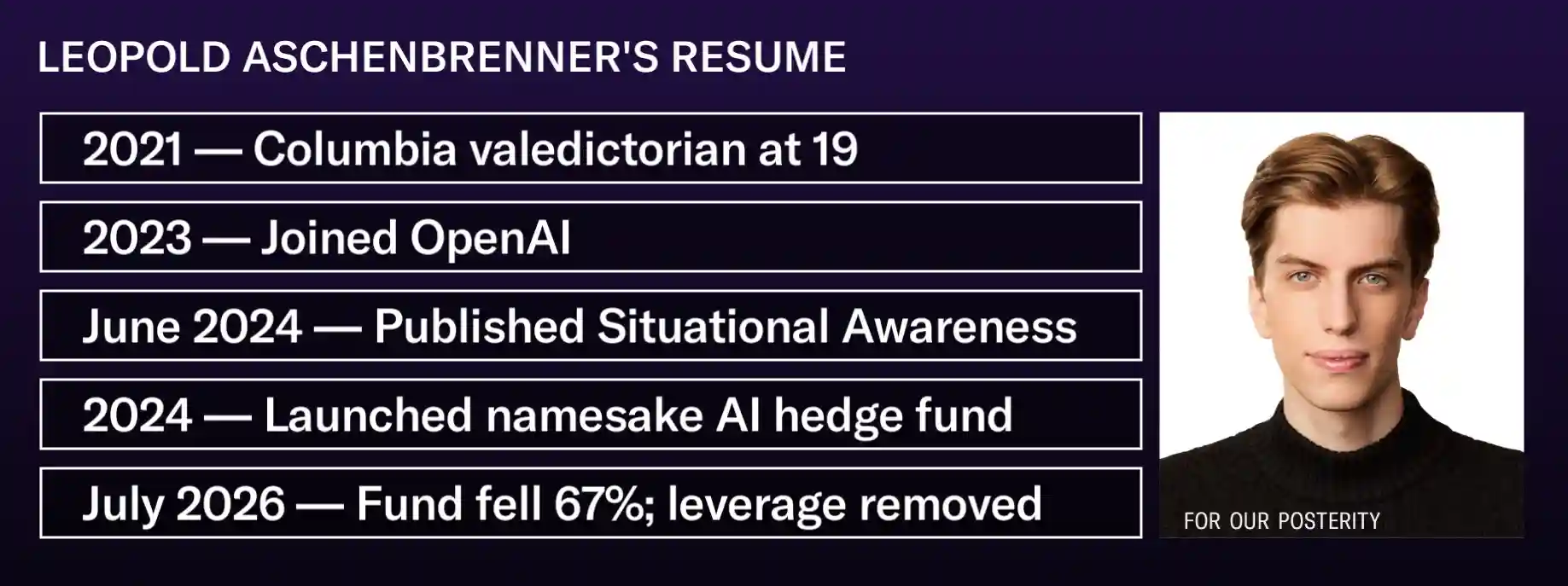
Leopold Aschenbrenner's Timeline
Here’s the part that makes this a story worth writing about, and not just another blow-up headline: Aschenbrenner’s thesis was right. His returns proved it. And he still got carried out.
I think this is the most instructive investing story of 2026 so far.
The rise: an essay becomes a $45 billion fund
If the name sounds familiar, it’s because Situational Awareness started as an essay. In June 2024, Aschenbrenner, then in his early twenties and freshly departed from OpenAI’s superalignment team, published a 165-page treatise arguing that AGI was coming faster than markets understood, and that the buildout of compute, chips, and energy would be the trade of the decade. Silicon Valley passed it around like samizdat. Then he did something unusual for an essayist: he raised a fund to bet on his own thesis, with anchor backing from people like Patrick and John Collison, Nat Friedman, and Daniel Gross.
And for two years, he was spectacularly right. Concentrated long positions in AI hardware (SK Hynix, Micron, Nebius) paired with shorts on software companies he believed AI would disrupt. The fund returned roughly 439% through June 2026, with cumulative gains north of 1,000% since inception. Assets under management peaked at about $45 billion in early July. A twenty-something first-time fund manager was outperforming virtually every institutional investor on Earth.
As a techie-turned-MBA, I’ll admit I found the whole arc irresistible. Here was someone who did the deep technical work, converted it into a differentiated macro view, and monetized it with total conviction. It looked like the platonic ideal of “edge.”
But conviction had a multiplier attached: the fund ran at roughly 4x leverage.
The fall: when both sides of your book lose
Then came July. The AI trade, the most crowded, most profitable, most consensus trade in the world, finally cracked. The Philadelphia Semiconductor Index dropped 28.6% from its June 22 peak. Chip stocks collectively shed more than $1 trillion in market value. Korea’s KOSPI hit circuit breakers as Samsung and SK Hynix fell 9-12% in single sessions. The Morgan Stanley Momentum TMT index, a decent proxy for “everything Situational Awareness owned,” collapsed 53.5%.
Now watch how the fund’s structure turned a drawdown into an execution.
The long book, those concentrated AI hardware names, fell 40-50%. Painful, but that’s what the short book is for, right? Except the software shorts rose. The market didn’t just sell AI hardware; it rotated into exactly the stocks Aschenbrenner was betting against. Both sides of the book lost money simultaneously. At 4x leverage, every percentage point of that combined loss hit the fund’s equity four times over.
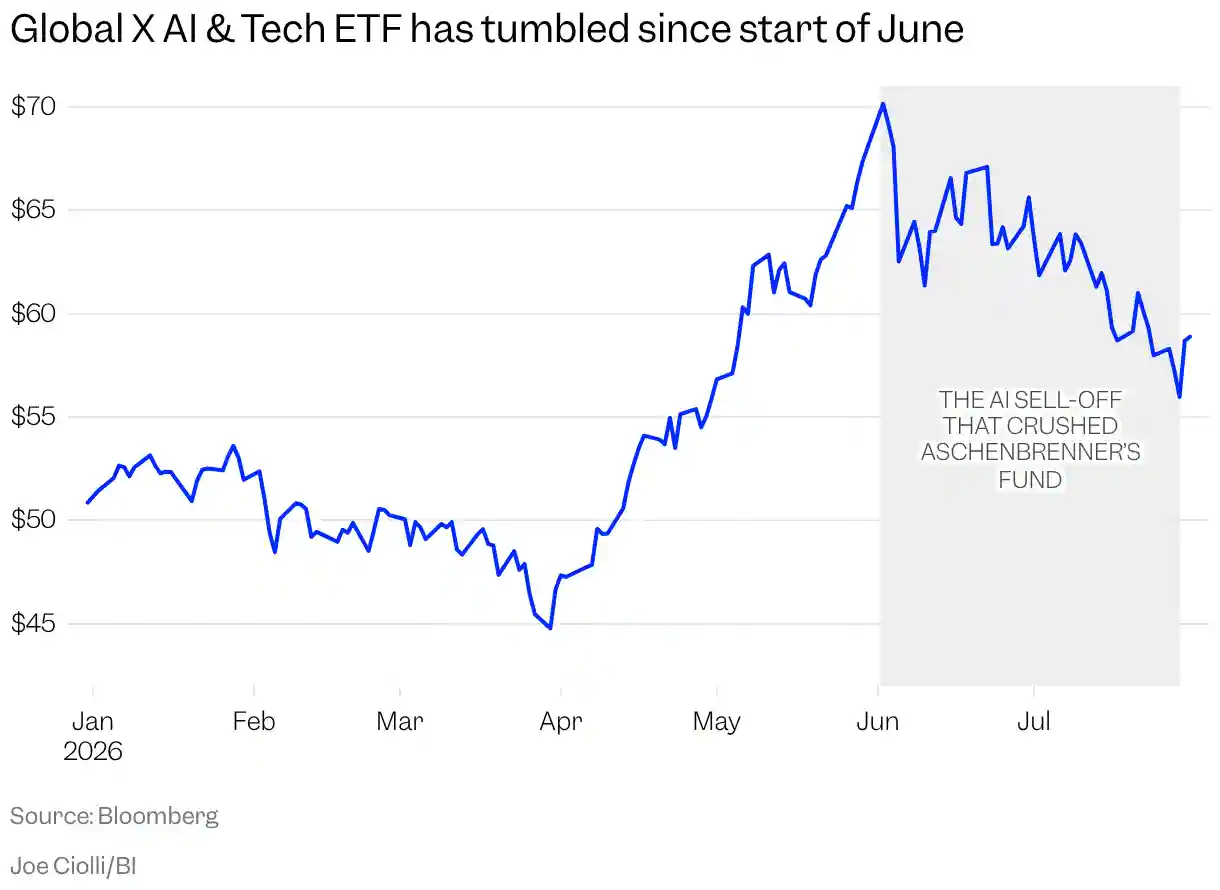
AI Stock Pullback in 2026
The margin calls arrived from three prime brokers at once. And when you’re a forced seller of $16 billion in a falling market, there’s really only one phone number to call.
Enter Citadel, the market’s undertaker
This is the third time Ken Griffin has played this exact role. In 2006, Citadel absorbed Amaranth’s natural gas book after its blow-up. In 2021, it injected capital into Melvin Capital mid-meltdown. Now it has taken down Situational Awareness’s entire public portfolio in a privately negotiated block sale.
There’s a lesson hiding in this pattern, and it’s not about Griffin’s genius. It’s about who has dry powder when it matters. Citadel gets to buy $16 billion of assets at fire-sale terms not because it out-analyzed Aschenbrenner on AI, but because it structured itself to never be the forced seller. In every liquidation, the profits flow from the leveraged to the liquid. That’s not a market anomaly. That’s the market working exactly as designed.
The twist everyone is missing
Here’s what caught me off guard when I dug past the headlines, and it’s the detail most of the “Archegos 2.0” hot takes skip entirely (ZeroHedge literally ran that headline).
Situational Awareness kept its private book. The forced sale covered public equities only. The fund retained its private holdings, including a significant stake in Anthropic, and with roughly $10 billion remaining, it’s still up around 80% for the year.
Read that again. A fund that lost 67% in a month and suffered one of the largest forced liquidations in hedge fund history is still beating the market in 2026. If your only crime is a 67% monthly loss and you’re still up 80% YTD, the underlying thesis wasn’t the problem.
The contrarian take: this wasn’t a failure of analysis. It was a failure of structure. The AI thesis survived July. The balance sheet didn’t.
And that distinction matters enormously, because the standard morality tale (“arrogant wunderkind gets humbled by the market”) teaches you nothing. The real lesson is sharper: you can be right about the destination and still not survive the route.
The echoes: LTCM, Archegos, and the oldest story in finance
The comparisons wrote themselves within hours. Long-Term Capital Management: brilliant team, correct-ish models, fatal leverage. Archegos: concentrated positions, borrowed money, margin calls, banks dumping blocks. Commentators reached for both.
But the differences are worth being precise about. Bill Hwang lied to his prime brokers about his concentration and was convicted of fraud. There is no such allegation here; Aschenbrenner’s brokers knew exactly what they were financing. LTCM’s models were wrong about correlation in a crisis. Aschenbrenner’s thesis about AI infrastructure demand may well still prove correct.
No, this is the purest version of the oldest story in finance: a good idea, levered until it becomes a bad one. Financial history is a graveyard of funds that started with a genuine insight, posted a period of incredible returns, attracted capital and confidence in equal measure, and then let leverage convert a temporary drawdown into a permanent loss. The idea didn’t fail. The financing of the idea failed.
There were even warnings visible in the data. Goldman’s prime brokerage flows showed hedge funds trimming tech-hardware exposure for four consecutive weeks heading into the selloff. The smart money was quietly walking toward the exits while the most levered player in the trade stayed fully committed. When everyone agrees with your thesis, the crowd itself becomes your biggest risk, because a crowded trade unwinding doesn’t care about fundamentals.
What this means for the rest of us
I have been reading a lot about financial nihilism, the retail version of the belief that only maximum-aggression bets can get you where you need to go. Situational Awareness is the institutional version of the same disease, and its collapse completes the argument. Because if a genuine genius, with genuinely superior information, running a genuinely correct thesis, can lose 67% in a month from leverage alone, what exactly is the retail trader’s edge in a 4x levered position?
Three beliefs this month sharpened for me:
- Position sizing is the strategy. Aschenbrenner’s stock-picking added enormous value; his sizing destroyed most of it. The uncomfortable implication: the boring decision (how much) matters more than the brilliant one (what). Most of us spend 95% of our energy on the wrong question.
- Time-horizon mismatch is the silent killer. The AI buildout thesis is a 5-10 year story. Margin loans are a daily story. Whenever your conviction’s timeline is longer than your financing’s timeline, you don’t actually own your position; your brokers do. Unlevered, July was a drawdown to endure. At 4x, it was an ending.
- Liquidity is a position. Citadel’s returns this month came from being able to answer the phone. For individual investors, the equivalent isn’t sitting in cash forever. It’s never being in a position where a 30% drawdown forces you to sell. The forced seller always loses to the patient buyer. Always.
The Stoic postscript
Charlie Munger’s first rule of compounding was to never interrupt it unnecessarily. It sounds like a platitude until you watch a 1,000% return streak evaporate in twenty trading days. Aschenbrenner compounded brilliantly for two years and then interrupted it, not because he was wrong, but because he built a structure where someone else could interrupt it for him.
Marcus Aurelius wrote that the impediment to action advances action: what stands in the way becomes the way. I’d offer the investing corollary. The drawdown you can survive becomes your compounding. The one you can’t becomes your obituary. The entire game, in the end, is arranging your affairs so that you’re never the one who has to sell.
The AI trade will recover or it won’t. But the $16 billion question was never about AI at all.
Further reading
- Situational Awareness fund: $45B to fire sale by CNBC
- Situational Awareness was forced to sell most of its stocks to Citadel, but kept its best asset by Yahoo Finance
- Chip stocks shed more than $1 trillion in the AI selloff by CNBC
- AI stocks face a new risk as hedge fund leverage unwinds by Forbes
- Situational Awareness, the original 2024 essay that started it all
- Financial Nihilism - “Giving Up”: The Impact of Decreasing Housing Affordability on Consumption, Work Effort, and Investment
Cheers 🥂